


Ruff Around the Edges: An Introduction to the Refreshing Sound of Raf Saperra
- Sep 23, 2023
- 10 min read

In my experience, many Punjabi-diaspora young adults who listen to Punjabi music every so often lean into an obsession with remixes on YouTube or SoundCloud of “classic/folk” vocals (or at least vocals that sounded like that) and drum-infused “trap-style” or dance beats. The rawness of often poorly recorded voices of artists like Kuldeep Manak, Surjit Bhindrakia, Chamkilla, Kaka Bhaniawala, Gurdaas Mann, and many more blended perfectly with the hard hitting emphasis of these computer made instrumentals. It helped a lot of younger people get in touch with the original classics themselves and appreciate how music was made in the time. It helped reduce the dichotomy many created within themselves between their “normal music” and their Punjabi music, of course helped by the fact that the current Punjabi mainstream began being ruled by hip hop fusion. In fact, I would argue it's one of the reasons many people latched on to the late Sidhu Moose Wala so quickly; his lyrics and the beats he wrote them over were bombastic and new, but his voice was so powerful and almost reminiscent of a time when singers would exclusively go around and perform at melas rather than focus on recording. I write all this to say that I often found myself wishing these mixes were on larger streaming platforms and wondering why more “mainstream connected” artists weren’t experimenting with Punjabi instrumentals and trap style in this way; when I listened to Ruff Around the Edges, I felt for a moment that I had found the man to do it in Raf Saperra.

Adeel Kureshii was raised in Streatham Hill, South London, in a ‘Pakistani’ Punjabi household. In his own words, he “was listening to bhangra at home and Giggs on the bus” while riding through the birthplace of UK Drill. While the UK and London specifically have a large Punjabi population of Sikhs, Muslims, and Hindus, South London was not one of those areas during his childhood; regardless, he took pride in both his heritage and ends and meshed them together as he came up in the music game, taking large inspiration not only from folk music, but also the (UK) bhangra and garage scene of the 90s and 2000s which approached music with similar ideas to which he does. Initially starting off as a dhol player, he describes an incident where people in his dhol class were singing boliyaan, and when he joined for the first time “jaws dropped to the floor” and they encouraged him to get some training. His slightly nasally and energetic voice comes right out of the folk tradition and exudes rawness and naturality. However, there is still a tinge of newness in both the voice and the music which ties in his South London upbringing.

When the opening song ‘Saperra (Gang Jatt Di)’ shot off, I was grinning ear to ear because it was exactly what I imagined I wanted to make and hear in my head. There is the infectious “dance” quality of Raf’s voice and the instrumentals, but the beat samples some G-funk sounds and interesting record scratches where Raf announces himself like the MCs of the past (“Its Raf Saperra, the Snake Charmer of the South''), while during the chorus the bhangra elements are played up. It is a beautiful mix of hip hop and bhangra vibes, and an apt intro not only to the mixtape but to Raf ‘Saperra'' himself, who knows he has new fans eager to discover him after the success of ‘Modern Mirza’ and ‘N.L.S.’ Furthermore, and I’m almost completely sure I’m reading into this too much as usual, but Raf’s identification with the ‘Saperra/Snake Charmer” tag feels like a sort of reclaiming of a stereotype and tease that many South Asians ran into growing up, and while he’s not the first he has reframed it in a truly hip-hop manner, using it to represent his finesse with women and his middle finger to the opps. Raf continues the streak with the energy infused bhangra track ‘Lalkaareh (Let the Boyz be Boyz)’ which is reminiscent of Jazzy B’s come up that is still remembered today at functions with songs like ‘Soorma’, and is a song that hasn’t been getting much recognition but one that has all the ingredients: lyrics about hanging with boys, killing your enemies, and dancing through it with a battery ting on a toombi dominated energetic beat.


The Naseebo Lal assisted ‘Jatti Lahore Di’ continues the folk sound and has the duet trading lines through the 4 minutes, something that has become all too uncommon recently, and while traditionally Punjabi must also be enjoyable for Pakistani fans who can see 2 Pakistanis talking about Lahore and Peshawar. ‘Tales of the Snake Charmer’ switches it up completely, acting as a lengthy interlude by underground British singer Myrgasmic, who croons in English over a laid back vibe perfect for late night drives and is a great RnB break in the tracklist. I know I sound like a broken record here, but the tracklist continues with perhaps the most traditional sounding (vocally) cut yet, ‘Taveet’, which is slower than the earlier cuts but captures the ‘mela’ feel the most, and has a slightly more romantic bend to it, singing “na gabru de naam da kude, sungiyaare to taveet tu banna lya” (with my name on it, you’ve got the jeweler to make you a necklace). Following this is another genre switch into popular single ‘N.L.S (Nach Le Soniye)’, a UK garage inspired dance track that has had success at Boiler Rooms and clubs, and ‘Badami Rangiye’ is an insanely catchy Afrobeats track featuring French vocals by Loun before Raf cuts in beautifully to give his fans a taste of what an Afro-Punjabi taste can sound like. Much like the rest of his music aims to do, it calls back to the 1990-2000s sounds of Apache Indian and collaborations of old while pushing forward the sound that has been brewing in anticipation for a while now due to relationships with Afro-European artists, culminating most recently in Nigerian giant Burna Boy announcing that he and Sidhu Moose Wala were planning a collaboration tape before his murder. As a Punjabi who knows French, this track was definitely a highlight in terms of enjoyability for me. Saperra then moves back into hip-hop with the lead single that introduced him to me, ‘Modern Mirza’, but it doesn’t feel out of place as the singer focuses on how he isn’t like folk story lover Mirza and won’t hesitate to put a bullet in whoever comes in between him and his girl (I think he has a ‘wrong’ recollection of the climax of the Mirza-Sahibaan story, but that’s neither here nor there). Everything about this song encapsulates how I introduced Raf Saperra at the beginning of this piece, and it was a great choice to use this as a single, given that it pushed me to listen to more from him.


Staying on the romantic subject, the next song is a slow ‘in my feels’ cut ‘Saare Umar (Desi Sad Joint)’, and while this isn’t one of my favorites on the tracklist it does its job and makes me excited to see what Raf can do in this arena and that he is aware that he should tackle multiple genres. As if he couldn’t represent his background anymore, the outro is ‘Mast Qalandar (Sufi Qawwali Joint)’, Saperra’s interpolation of the classic qawwali ballad that acts almost as a rite of passage for many (especially Pakistani) singers. He doesn’t particularly infuse this with many “modern” elements, but rather tries to show off his singing chops in a more traditional manner, and is even under the tutelage of Latafat Ali Khan, who belongs to a legendary family of singers. With this, we have been introduced to the enigma of Raf Saperra spanning multiple sounds of boom-bap, bhangra, folk, garage, hip-hop, and even qawwali all within one project, while still feeling authentic to himself, his roots, and his upbringing.
Another quality this album has that has been missing recently in the Punjabi music scene is a sort of ‘cinematic’ quality within the album itself. Many artists have sought to use their solo music to distinguish themselves from playback singers of movies (rightfully so, in my opinion), but in acknowledgement of his hip hop and London background Raf has been able to bring that trait without it feeling too too forced, cheesy, or not allowing the project to stand on its own. Although Raf correctly calls this a mixtape, it has more of an album feel to it than many other Punjabi albums from the last 2-3 years, excluding perhaps parts of Moosetape. First are the various skits and interludes sprinkled between every couple of songs. The ‘Table Top Boliyan’ prelude to ‘Taveet’ feels so raw and great and calls back to the origins of Raf’s singing. ‘Aunty Killer!’ pokes fun at the whole radio show motif of mixtapes (this one included) while still being hilarious in and of itself, as you can tell from the name. These aren’t the only ones, but overall the skits help transition between the different parts of the album and add to it being its own experience. While I enjoyed the skits, I wouldn’t be mad at a listener who suggests that there were perhaps 1 or 2 too many, and I’m sure the quality of them will increase as Raf’s career moves on if he decides to do this again.

Quite in key with the whole theme of exploring the ‘movie’ of finding Raf Saperra, many of the songs receive the touch of Adeel Kureshii that made him famous in the first place: high quality music videos. Often looked at as the “most useless” expense for record labels and artists, Kureshii still indulges in the “mandem, cars, and dancing” scenarios for his videos but shoots them in a way that really does elevate his sound; while I think he is a talented director, I think the videos that have best showcased his talents are the ones for himself because that synergy already exists. The ‘Saperra + Taveet’ 2 part video does so many things right while maybe being the simplest video he’s done: film shooting, all of his boys around him, and quick cuts between different sceneries. We see kebab shops, tractors and trucks next to a Rolls Royce, and just pure Punjabi fun with some bhangra in front of the shops. Plus, as someone who lived in London for a bit, the rainy night around the donor shops open till odd hours with their neon signs just felt so right and fun, and given that this was the first way I listened to both of these songs, elevated their enjoyment and my diving into the artist. The synergy of folk, Punjabi, and London culture is on full display here. The ‘Lalkaareh’ video is more of the same, but again visualizes the whole ‘hanging with your gang on top of the world’ vibe out in parking lots, restaurants, and concerts, cementing it as an ode to early 2000s UK bhangra. Kureshi keeps with the captivation of simplicity in the ‘N.L.S’ video, showing a daylight “garage” party the song is made for, with small numbers, a singer like Raf, light partying, Yung Singh (who played a major part in promoting the song at Glastonbury) on the table, and (as much as I hate simplifying things to this) pure vibes. The ‘old-school digital’ style filming captures this garage idea as well. Despite it being the most rap-inspired track, the ‘Modern Mirza’ video takes our movie across the world to Lahore, arguably the historic heartland of Punjab, and is perhaps the best video for the whole tape. It showcases different shades of the city with top tier visuals, and while showing the East is still hip-hop through and through, an ode to his “ancestral city” like so many musician origin stories do. Kureshi is still growing as a director, but he clearly has an eye for captivating yet simple shots for videos that are meant to capture a moment. I would love to see him tackle a storyline sort of extended video as well, and he clearly had a vision for establishing that in his music to some degree. Another small but amazing detail is the use of subtitles in his videos; so often when people try to translate Punjabi lyrics they either become too literal, ignoring any wordplay, or inject too much of their own interpretation and butcher the intention. Raf controls his own narrative, and not only translates it to English but using the “slang” intention, and for a diaspora listener like me (and like Raf and probably most of his audience) it really helps with the enjoyment of the music and understanding of lyrics and words not always used in family conversation.

There are, of course, aspects left to be desired as with any debut project. The lyrics for the most part are essentially more of the same that we have been seeing in Punjabi music for a while now; drinks here, guns here, cars there, etc etc. There are even some confusing contradictions likely stemming from different writing sessions or maybe even different writers; for example, ‘Saperra’ and ‘Taveet’ have a combined video. In the second verse of the former, he sings (in his own translations) “girl I stay sober and don’t sip bad liquor”, but he begins the latter with “you got mandem drinking barrels upon barrels // they’re no longer phased by village liquor or rum.” However, despite these cliches, maybe because almost everything else works, the lyrics still feel real and not as… degenerative as they may normally. The lyrics and subject matters aren’t necessarily the strengths of this tape, but the “content” works… if that makes any sense.
This may have not been a traditional music review; I focused less on specific lyrics, instrumentals, and tracks themselves and instead tried to give an introduction to the mixtape and a briefer for each moment, because the main message isn’t just this project-of-the-year contender but introducing the man behind it. Unfortunately it doesn’t seem like the tape has received too much widespread attention yet among the masses when it comes to discussion, or if it has not to the level it deserves (I could be wrong about this). Regardless, Raf Saperra has the potential to be the artist of a generation. This is emphasized given the unfortunate killing of Moose Wala and the relatively disappointing (at the time of the release of Ruff Around the Edges) recent EPs of other rising stars like AP Dhillon, Shubh, and Tegi Panu.

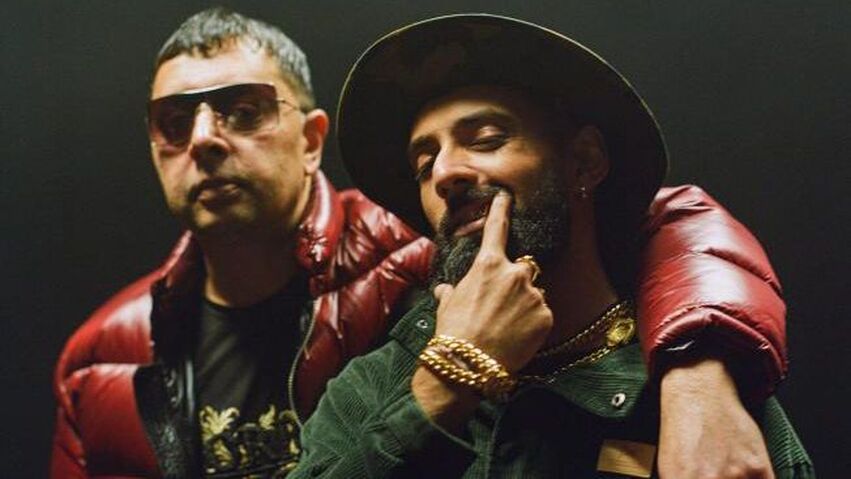

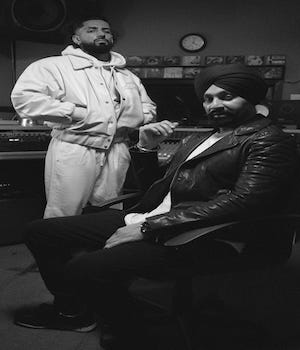



Raf being embraced by the community: Panjabi MC, Sukshinder Shinda, Sidhu Moose Wala, Jazzy B, and Gurdas Maan
Punjabi music as a whole has been bubbling at the brink of breaking through to more international audiences since its brief, largely forgotten/misremembered run in the early 2000s. He can authentically combine his London grime and charisma and Punjabi musicality to help push that through. In his brief career he already has cosigns from Punjabi music juggernauts like folk singers Gurdaas Maan and Master Saleem, UK Bhangra leaders Sukshinder Shinda, Dr. Zeus, Panjabi MC, respected contemporaries like the late Sidhu Moose Wala, and Jazzy B, showing that his tributes are truly appreciated and just how organic his growth is. While many songs in his debut project call back to Punjabi music of old (which makes sense give this is his “backstory”), he is very clear in interviews that he doesn’t want to only be seen as someone who harkens to the past nor as “the future”, but rather a present leader in the Punjabi scene. In my opinion he has essentially etched himself at the top of the UK game, at least in the moment; I believe he can be that for the whole diaspora, from Amritsar to Lahore, from London to Toronto, from LA to Sydney.

Here I have an interview Raf gave with The Face which gives a lot of great insight, a rough first-listen personal ranking, and some places to start looking to read about the origins of the old UK Bhangra scene , all worth checking out:
Saperra (Gang Jatt Di)
Modern Mirza
Lalkaareh (Let Tha Boyz Be Boyz)
N.L.S (Nach Le Soniye)
Badami Rangiye (ft Loun)
Tales of The Snake Charmer (ft Myrgasmic)
Taveet
Mast Qalandar (The Sufi Qawwali Joint)
Jatti Lahore Di (ft Naseebo Lal)
Saari Ummar (Desi Sad Joint) (ft Laftatat Ali Khan)


Comments